Case study · WeSource

After three prototypes, we learned neighbors don't want price tags on kindness, just a trusted Circle and the freedom to give back however they can.

In 2020, Chicago's mutual aid networks met every request that came in. WeSource turns that into an app where neighbors trade goods, skills, and time inside private Circles. No money. Just people.
My role
Co-Founder & Product Manager. Drove every pivot, then led the build.
Team
Chrissy, Kenny, Shiri & Liz, backed by the 1871 Chicago incubator
Timeline
Research in 2024 → live beta in August 2026
Proof so far
148 surveys, 20+ testers, 3 real trades in beta
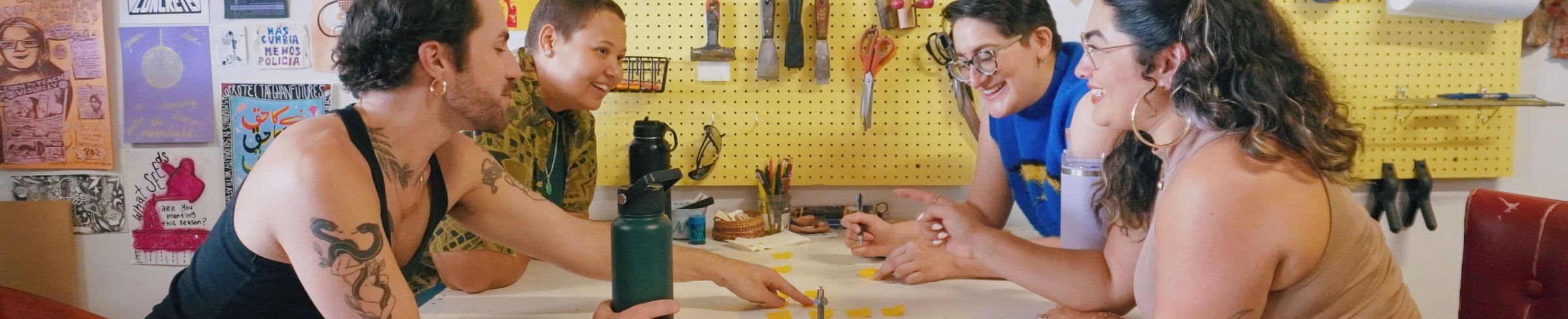
Four WeSource teammates laughing around a worktable covered in yellow sticky notes, with a pegboard of tools behind them
The WeSource team sorting research insights, one sticky note at a time.
A real trade from the beta

One neighbor gave away 50 moving boxes and asked for one thing back: help down three flights of stairs.

No price. No 1:1 trade. Just a need, an offer, and a Circle that showed up. That's Optional Exchange working exactly the way we designed it.
Offering · Physical items

50 heavy-duty moving boxes

Shared with your Circle
What would you welcome in return? (optional)A hand carrying boxes down from my third floor
Connect
How we got here

Why we made the calls we made

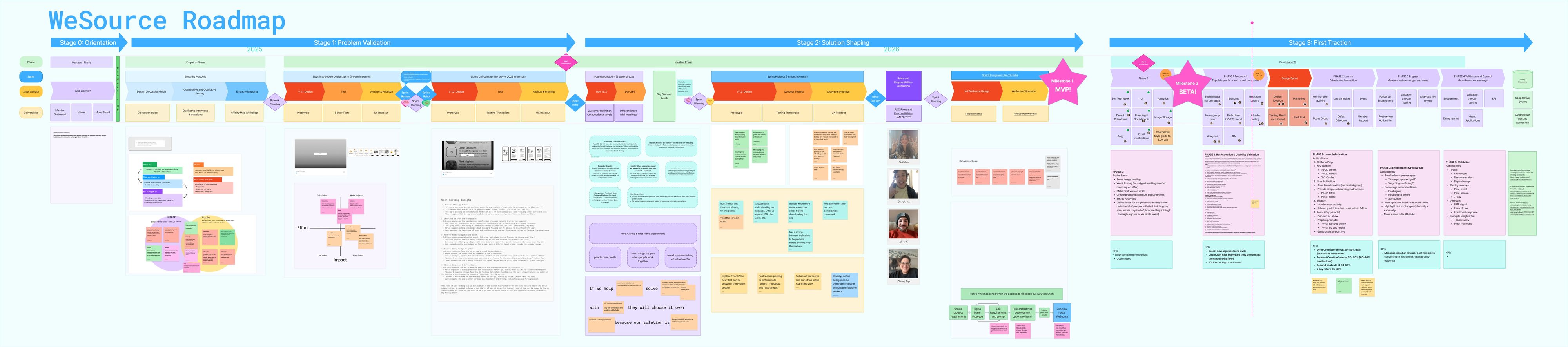
WeSource roadmap board spanning four stages: Orientation, Problem Validation in 2025, Solution Shaping in 2026, and First Traction, with sprints, research boards, team photos, and the MVP and Beta milestones marked
The whole journey on one board. Four stages, three sprints, one Foundation Sprint, and two milestones (MVP, then Beta). I built this roadmap and kept it current, so the whole team always knew where we were and what came next.Open full size ↗
01Research · 2024

148 people told us the shortage wasn't stuff. It was trust.

We ran 7 interviews and surveyed 148 people, expecting to hear "I don't have enough." Instead we heard that asking for help is hard, giving help leads to burnout, and people only share with folks they know.

The SeekerLooks for help, guidance, or know-how. Students, learners, newcomers.
The GuideShares tools, wisdom, and skills. Teachers, coaches, the neighbor with a drill.
02Sprint 1 · Flourish Board
March 2025

Testers loved our first prototype and asked one painful question: how is this different from Facebook Marketplace?

  • 4 of 5 loved the community feel
  • 3 of 5 couldn't tell if it was for items, events, or services
  • 3 of 5 wanted proof of trust (verified profiles, history, reporting) before swapping anything
03Sprint 2 · Daffodil
April to May 2025

We fixed trust and the look, but people still couldn't say what the app was for.

The classic 5-day sprint wore the team out, so we reshaped it into 6 days spread over 2 weeks. Each designer owned one feature: trust and safety, who sees your posts, onboarding, and community.

Testers called the verification screens "reassuring" and the visuals "calming." Clarity still didn't land.

04Foundation Sprint
2025

We stopped asking "how do we explain this?" and asked "what do we actually believe?"

Using the book Click, we named our real rival (Facebook exchange groups) and wrote a manifesto to steer every decision after.

"Our product must be free, caring, and based on firsthand experience. We prioritize people over profits."
BeforeA marketplaceListings anyone can browse
The turnFoundation SprintValues, rival, belief
AfterTrusted CirclesUrgent, heartfelt asks among people you know
05Sprint 3
2025

We swapped "Life Event" for "Time-Sensitive Request," the words testers already used, and all 5 could finally explain WeSource unprompted.

Testers told us they share with friends, then friends of friends, and nobody else. That became Circles, the heart of the product.

Sprint 12/5
Sprint 22/5
Sprint 35/5
Testers who understood what the app was for
My call

I made the call to launch with private Circles of trust first, then open up to user-created Circles once we learn how people's trust actually works.

06Optional Exchange

We dropped the 1:1 trade rule and asked "What would you welcome in return?" so neighbors give back on their own terms.

A price or a strict swap turns a favor into a deal. An optional prompt lets people return kindness based on what they can give and who they're helping. That's the line between WeSource and a marketplace.

A craft workshopTaught to a Circle, paid back in good conversation and time together.
Bass lessonsRequested by one member, picked up by a teacher already inside the Circle.
07Live beta
August 2026

An incubator told us to ship it, so we skipped the polished MVP and vibe-coded a live app.

1871 Chicago's advice: get real people using it to find out if it fits. As the team's most technical member, I led the build: architecture, QA, email, and image storage. We also renamed from Ayllu Design Collective to WeSource and wrote a plain-language system: Share an Offer → Make a Request → Connect.

5members in the pilot Circle
5posts
3completed trades
Five beta screens in a row: Landing with the line No money. Just people., How It Works, About, Log In with community guidelines, and the Home Feed of Circle posts
The live beta, screen by screen. Landing, How It Works, About, Log In with community guidelines, and the Home Feed of Circle posts.Open full size ↗
08What's next

One pilot Circle, four steps to a launch decision.

  1. Re-activateBring back past testers and confirm our fixes worked. Go or no go?
  2. SeedStart with 10 to 20 offers and needs across 2 to 3 Circles, then invite a small group.
  3. NudgeEncourage a second trade and share real stories as proof.
  4. Prove itBundle usage, ease of use, and how people felt into pitch materials.
The tail

Extra fiber for the curious

The great Sunday 2PM debate

Sprint 1 only allowed posts at a set weekly time. Calm for some testers, a cage for others. We let it go.

Words we changed

  • "Life Event" → "Time-Sensitive Request"
  • "What can you offer in exchange?" → "What would you welcome in return?"
  • People: Members, Community, Circles

The "MaxiPad" pilot

A household Circle with outer "wings," moderated by Shiri to watch real behavior up close. One month of use, then a debrief.

What we're measuring

Do people post without a nudge? Do real trades happen? Do they come back and trade again? Tracked with PostHog.

The toolkit

Figma Make → Claude → Bolt.new → PostHog

Lines that survived every rewrite

No money. Just people.
Share what you have. Get what you need.